Struggling with poor visibility and safety on the field? Football field lighting plays a critical role in both player performance and viewer experience. Without proper lighting, matches can be dangerous, and fans may miss crucial moments. The solution is high-quality LED lighting designed for football fields to ensure visibility, safety, and efficiency. Let’s dive into the key factors you need to know.
Football field lighting requirements are centered around ensuring proper illumination for both players and spectators. To meet these needs, it’s essential to have uniform lighting across the entire pitch. The main goal is to achieve sufficient lux levels for clear visibility of the ball and players, while minimizing shadows and glare. Football lighting should be consistent, with a maximum contrast between light and dark areas to avoid any potential hazards. Additionally, floodlights should be positioned and angled to eliminate uneven lighting, ensuring safety and optimal viewing conditions.
It’s vital to consider several factors for your football field lighting setup. Continue reading to explore the essentials of designing the perfect lighting system.
Illuminance Levels for Football Fields
The illuminance level of a football field is one of the most important factors for ensuring proper visibility during night matches. It determines how bright the field will be for players, referees, and spectators. The illuminance is measured in lux (lx), and different levels are required based on the type of match, ranging from recreational games to high-level professional events.

Here are the standard illuminance levels for various types of football games:
1. Recreational or Amateur Matches
- Illuminance: 200-300 lux
- This level is sufficient for casual games, training sessions, or amateur leagues where high-quality visibility is not as critical.
- It allows players to see the ball and field markings clearly, but may not provide optimal clarity for broadcast or large-scale events.
2. Semi-Professional or Competitive Matches
- Illuminance: 300-500 lux
- This range is suitable for more competitive matches, such as regional leagues or club games, where better visibility is required. It enhances player performance and helps spectators see the action more clearly.
3. Professional Matches
- Illuminance: 500-700 lux
- This level of lighting is typically used for professional football matches that are not broadcast live but still require high-quality lighting to ensure safety and clarity for players, referees, and viewers.
4. Televised or High-Definition Broadcast Matches
- Illuminance: 1000-1500 lux
- For televised events, lighting needs to be much brighter and more consistent across the field. This ensures that cameras can capture the action in high-definition, providing viewers with clear, sharp visuals. This lighting level is commonly used for major league matches and international competitions.
5. International or Major Event Matches (e.g., World Cup, Champions League)
- Illuminance: 2000-2500 lux (sometimes even higher)
- Major international events often require an exceptionally high level of illumination to accommodate large audiences, live broadcasts, and high-quality HD or 4K television. This ensures maximum clarity for both players and viewers.
Why Illuminance Levels Matter
- Player Safety: Adequate illuminance is crucial for ensuring player safety. Low light levels can cause players to miss the ball, leading to accidents or injuries.
- Clarity: The ball, player movements, and field markings must all be visible for optimal gameplay, and proper lighting allows for this.
- Broadcasting: High-level illuminance ensures that televised matches are visually clear, with sharp contrasts and details captured by cameras.
- Spectator Experience: Good lighting also improves the visibility for fans, whether they are watching live in the stadium or on TV.
In summary, the illuminance level for a football field must be carefully selected based on the type of match and its viewing requirements. From 200 lux for recreational games to 2000 lux or more for high-profile international matches, each level provides the right balance between safety, clarity, and broadcast quality.

Uniformity of Lighting for Football Fields
Uniform lighting is essential for creating a fair and safe environment for players, referees, and spectators. The uniformity ratio ensures that the light is distributed evenly across the field, minimizing dark spots or areas with excessive brightness. This is crucial for improving visibility, enhancing player performance, and preventing accidents.
What is Uniformity of Lighting?
Uniformity refers to the even distribution of light across the entire football field. It helps to ensure that no part of the field is too dark or too bright, allowing players to track the ball easily and move around without visual obstacles.
The uniformity ratio is calculated as the ratio between the average illuminance (the average light level across the field) and the minimum illuminance (the light level at the darkest spot). This ratio helps determine how evenly the lighting is distributed.
Standard Uniformity Ratios
The ideal uniformity ratio varies depending on the level of play:
- Recreational or Amateur Matches:
- Uniformity ratio: 0.7
- This ratio ensures that the lighting is somewhat consistent but may still have slight differences in brightness across the field.
-
Semi-Professional or Competitive Matches:
- Uniformity ratio: 0.75 to 0.8
-
For competitive play, a higher uniformity ratio is needed to ensure that players can see the ball and field markings clearly in all areas.
-
Professional Matches:
- Uniformity ratio: 0.8 to 0.85
-
This level of uniformity is typically required for professional matches. It ensures that lighting is consistent and there are no noticeable differences in brightness, which can affect gameplay.
-
Televised or High-Definition Broadcast Matches:
- Uniformity ratio: 0.85 to 0.9
- For televised events, high uniformity is essential for producing clear and consistent visuals on camera. Any uneven lighting can lead to distracting shadows or bright spots that interfere with the viewing experience.
Why Uniformity Matters
- Player Performance: Consistent lighting ensures that players can focus on the game without being distracted by bright spots or dark shadows. It allows them to track the ball more effectively and move safely across the field.
- Reduced Glare and Shadows: Poor uniformity can create glare or dark areas that obscure parts of the field, which can be dangerous. Good uniformity minimizes these issues and enhances player visibility.
- Broadcast Quality: For televised events, uniform lighting is critical. Uneven lighting can result in distracting visual effects, such as washed-out areas or too-dark spots, which can impact the quality of the broadcast.
- Spectator Experience: A uniformly lit field ensures that spectators in the stadium can enjoy the game without being distracted by uneven lighting. It also improves the experience for viewers watching on TV.
To achieve a good uniformity ratio, proper lighting design is essential. The layout of light poles, the type of fixtures used, and the intensity of light each fixture provides all play a role in ensuring even coverage. Lighting systems using modern LED technology are especially beneficial because they offer better control over beam angles, reducing dark spots and enhancing uniformity.

Color Temperature for Football Fields
The color temperature of lighting is a crucial factor in enhancing visibility and creating the right environment for players, referees, and spectators. It refers to the warmth or coolness of the light and is measured in Kelvin (K). The ideal color temperature for a football field depends on the intended use, the time of day, and the overall ambiance needed for optimal play and viewing.
What is Color Temperature?
Color temperature describes the color appearance of the light emitted by a lamp. It is measured in Kelvin (K), where lower values indicate warmer (yellowish) light and higher values indicate cooler (bluish) light. The color temperature of lighting influences how well details are visible on the field, as well as how players and the ball appear to both participants and spectators.
Recommended Color Temperature for Football Fields
For football fields, the recommended color temperature typically falls within the range of 4000K to 5000K. Here’s a breakdown of the most suitable options:
4000K – 4500K (Neutral White)
– This is often considered an ideal range for football fields. It provides a neutral white light that is not too warm or too cool. This temperature is bright enough to highlight field markings and the ball while ensuring the environment is visually comfortable for both players and spectators.
– This range is common for semi-professional and recreational matches.
4500K – 5000K (Cool White)
– A cool white light is typically used for professional and televised events, as it helps improve contrast and sharpness on the field. It creates a crisp, clear image, making it easier for both players and cameras to capture details.
– Cool white light mimics daylight, which enhances visual clarity and helps players track the ball more easily.
Above 5000K (Daylight)
– For high-end professional events, such as international matches or tournaments, you may see color temperatures as high as 6000K or more. This light provides maximum contrast and clarity, similar to natural daylight, and is ideal for high-definition broadcasts.
– While it’s suitable for high-profile events, this temperature is less commonly used for standard games because it can be harsh and cause discomfort for spectators over extended periods.

Light Color Temperature
For football fields, 4000K to 5000K color temperature is ideal. This range offers a balanced light that enhances visibility, player focus, and broadcast quality. Cool white light (4500K-5000K) is particularly preferred for professional and televised matches, as it mimics daylight and improves clarity. By selecting the right color temperature, you can ensure the best lighting experience for players, referees, spectators, and TV viewers.
Pole Configuration and Height for Football Fields
The pole configuration and height play a crucial role in the effectiveness of the lighting system for a football field. Proper placement and height of the poles ensure that the field is uniformly lit, reducing shadows, minimizing glare, and providing optimal visibility for players, referees, and spectators. Below is a detailed breakdown of the key factors to consider.
Pole Height
The height of the poles determines how far the light will spread across the field and ensures that the lighting system can provide even coverage. The recommended height varies depending on the size of the field, the type of match, and the level of illumination needed.
Recreational or Amateur Matches:
– Pole height: 10 to 15 meters (33 to 49 feet)
– For smaller fields or amateur matches, shorter poles are typically sufficient. These provide enough coverage while keeping costs down.
Semi-Professional Matches:
– Pole height: 15 to 20 meters (49 to 66 feet)
– For competitive or semi-professional games, slightly taller poles are needed to achieve a more uniform distribution of light across the field. This ensures better visibility for players and spectators.
Professional Matches:
– Pole height: 20 to 30 meters (66 to 100 feet)
– For professional-level games, including televised matches, taller poles are necessary. These poles can support high-powered lights and provide better coverage for the entire field. Higher poles also help reduce glare and shadows, especially when using high-intensity lighting like LEDs.
International or Major Event Matches:
– Pole height: 30 meters or higher (100 feet or more)
– For large-scale events such as international tournaments or World Cup matches, the poles must be very tall. This height allows for even light distribution and helps achieve the high illuminance levels required for broadcast quality.

Pole Placement
The placement of the poles around the field is equally important for achieving uniform lighting. A strategic layout helps minimize shadows and ensures that light reaches all areas of the field evenly.
Perimeter Layout:
– The poles are typically placed around the perimeter of the field, with some placed near the corners and along the sidelines. This arrangement reduces the potential for uneven lighting and minimizes the shadowing effect caused by players or goalposts.
– In professional settings, multiple poles are placed in each corner to provide extra lighting power and control.
Height of Poles at Corners:
– Poles at the corners of the field are usually the tallest, ensuring that the light is cast at the correct angle to illuminate the entire surface. This also helps reduce dark areas near the goalposts, which could obstruct players’ and referees’ views.

Symmetry:
– The layout must be symmetrical to ensure uniform light distribution. Uneven placement can lead to shadows or overly bright spots in certain areas, which can distract players and affect their performance.
Consideration of Obstacles:
– When placing poles, it is important to consider any existing obstacles, such as nearby buildings, trees, or structures. These can block light and create uneven lighting conditions. Careful planning is required to avoid obstructions and ensure optimal coverage.
Lighting Distribution and Angle
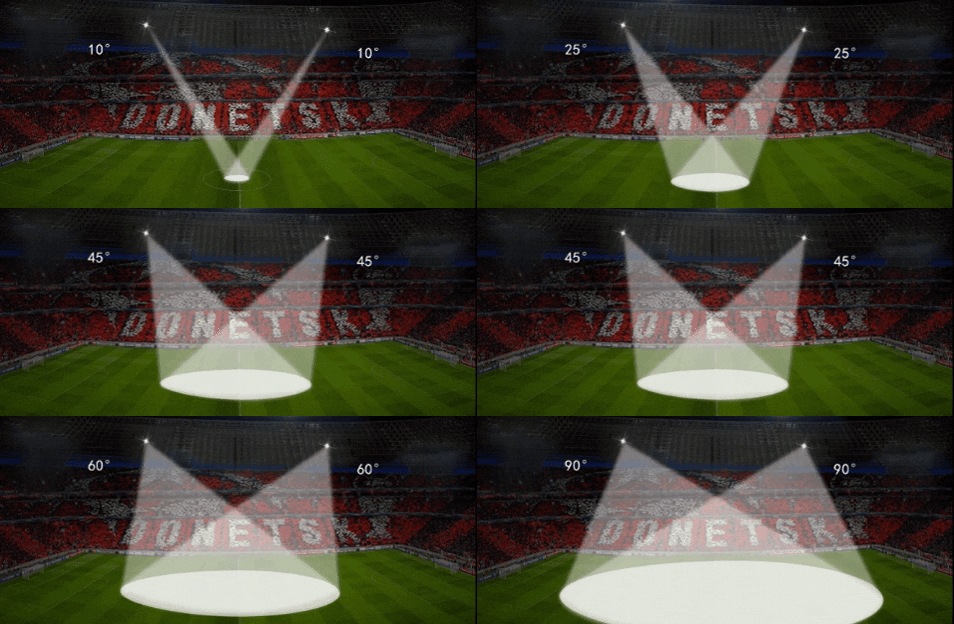
To achieve optimal lighting, poles should be angled in such a way that they direct light at the appropriate areas of the field. Most modern lighting systems use adjustable floodlights that can be angled to achieve the best coverage.
- Floodlights on poles are typically mounted at an angle, allowing for better coverage of the field. The angle of the light helps reduce shadows on the players and allows for more even illumination.
- The beam spread of the lights must be wide enough to cover the entire field, ensuring that no part of the playing surface is left in darkness.
Lighting Technology for Football Fields
The right lighting technology is essential for ensuring optimal visibility, safety, and broadcast quality on a football field. Choosing the right type of lighting system helps reduce energy consumption, minimize maintenance costs, and provide the best environment for both players and spectators. The most commonly used lighting technologies for football fields today are LEDs, but other options, such as metal halide and high-pressure sodium lights, have been used in the past.
1. LED Lighting: The Ideal Solution for Football Fields
LED (Light Emitting Diode) technology is widely considered the best choice for football fields. LEDs offer a range of benefits over traditional lighting systems, making them the preferred option for modern sports lighting.
Benefits of LED Lighting:
- Energy Efficiency: LEDs are highly energy-efficient, consuming much less power than older lighting technologies such as metal halide or halogen lamps. This helps reduce operating costs significantly, especially for large fields or professional venues where lights are used frequently.
-
Long Lifespan: LED lights have a much longer lifespan than traditional bulbs, lasting up to 50,000 hours or more. This reduces the need for frequent replacements, which can be costly and disruptive to the field’s use.
-
Instant On/Off: LEDs provide instant light without any warm-up time. This makes them perfect for applications where lights are frequently turned on and off or need to be dimmed. This is especially useful for events and training sessions.
-
High-Quality Light: LEDs provide bright, uniform, and consistent light with very little color degradation over time. This ensures clear visibility for players, referees, and spectators, even during long matches or in the early evening hours.
-
Adjustable Brightness: LEDs can be easily dimmed or adjusted to different brightness levels, allowing for flexible lighting control depending on the event. For example, lighting levels can be increased for high-definition broadcasts or lowered for training sessions.
-
Environmentally Friendly: LEDs are free of harmful substances like mercury, which is found in some older lighting technologies. This makes them a more environmentally friendly option, aligning with sustainability goals.
-
Low Heat Emission: Unlike metal halide lamps, which generate significant heat, LEDs produce very little heat, reducing the risk of overheating and extending the life of the lighting system.

Applications of LED Lighting:
- Televised and Professional Matches: LEDs are especially useful for high-profile events that require high-quality lighting for broadcast purposes. The ability to achieve uniformity, clarity, and brightness makes them ideal for these types of matches.
-
Training and Recreational Matches: Due to their energy efficiency, LEDs are also a great choice for recreational or amateur games. They provide sufficient light for these settings while minimizing energy consumption.
2. Metal Halide Lights: The Older Technology
Metal halide lamps were commonly used for sports lighting in the past, especially for larger stadiums or football fields. These lamps are known for their bright light output but have several drawbacks compared to LEDs.
Characteristics of Metal Halide Lighting:
- Higher Energy Consumption: Metal halide lights consume more power than LEDs, leading to higher operational costs over time. This can be especially problematic for large sports venues.
-
Long Warm-Up Time: These lights require several minutes to warm up before reaching full brightness. This delay can be an issue for events that need instant lighting or require frequent on/off switching.
-
Shorter Lifespan: Metal halide bulbs have a relatively short lifespan (around 10,000 to 20,000 hours), which means they need to be replaced more frequently than LEDs, increasing maintenance costs.
-
Heat Production: Metal halide lights produce a significant amount of heat, which can affect player comfort and increase the cooling needs in stadiums.
Applications of Metal Halide Lighting:
- Older or Existing Venues: Many older stadiums and sports venues that were built before LED technology became mainstream still use metal halide lights. These systems can be replaced with LED lights for improved energy efficiency and performance.
3. High-Pressure Sodium (HPS) Lights
High-pressure sodium (HPS) lights are another older lighting technology that has been used in some sports applications. While these lights are energy-efficient, they have several limitations when compared to LEDs and metal halide lights.
Characteristics of High-Pressure Sodium Lights:
- Energy Efficient: HPS lights are relatively energy-efficient but not as efficient as LEDs. They are commonly used in street lighting but are less effective in sports lighting applications.
-
Poor Color Rendering: One of the main drawbacks of HPS lights is their poor color rendering, making it difficult for players and spectators to distinguish between colors. This is especially problematic in sports like football, where color contrast is essential for visibility.
-
Long Warm-Up Time: Like metal halide lights, HPS lights take several minutes to reach full brightness, which can be disruptive during events that need immediate illumination.
Applications of High-Pressure Sodium Lighting:
- Low-Cost Applications: HPS lights are occasionally used for budget-friendly lighting systems, but they are generally being phased out in favor of LED technology, which offers better performance and energy savings.
LED lighting is the best choice for modern football fields due to its energy efficiency, long lifespan, and high-quality light output. Whether you’re lighting a professional stadium or a recreational field, LEDs provide clear, uniform lighting that enhances visibility and player performance while lowering operational costs. While metal halide and high-pressure sodium lights are still used in some venues, the advantages of LEDs make them the ideal solution for any football field looking to optimize its lighting system for both performance and cost efficiency.

Lighting Technology and Pole Configuration
- The type of lighting technology used, such as LEDs, affects the pole configuration. LEDs produce high-intensity light and can be precisely focused, so fewer poles may be needed compared to older lighting technologies like metal halide lamps.
- LED fixtures are often placed at higher elevations, using the pole’s height to provide a wider coverage area with fewer fixtures.
What is the standard lighting for a football field?
The standard lighting for a football field varies depending on the level of play, but there are general recommendations that apply across most scenarios. For a recreational or amateur football field, the minimum lux level should be around 200 lux. For semi-professional matches, this increases to around 500 lux, while professional games typically require a lux level of 1000 lux or higher. FIFA’s standards dictate that for international televised matches, the required lux level is 2000 lux. These values ensure that the field is well-lit for both players and spectators, making the game safer and more enjoyable.
What are the lighting levels for sports fields?
The lighting levels for sports fields depend on the type of activity being performed. For general recreational use, lighting levels of 200 to 300 lux are typically sufficient. For competitive and professional sports, however, higher levels are necessary. For instance, football fields require between 500 to 2000 lux depending on the level of competition. In areas where the game is broadcast live, like FIFA World Cup matches, lighting can reach as high as 2500 lux to ensure perfect clarity on TV screens. Higher lux levels improve visibility, making it easier for both players and viewers to engage with the game.

What are the lighting regulations for sports?
Sports lighting regulations are defined by various bodies like the International Association of Athletics Federations (IAAF) and FIFA. These regulations are designed to ensure that lighting systems provide a high-quality experience for players and spectators. For football fields, FIFA specifies minimum and maximum lux levels based on the type of match (e.g., local, national, or international). These standards also emphasize the reduction of glare and light pollution while providing uniform lighting. It’s crucial for stadium designers and owners to follow these regulations to meet the required lighting performance and ensure compliance.
How many lumens to light a football pitch?
The number of lumens required to light a football pitch depends on the field size and the desired lux level. Typically, to achieve 1000 lux, the total lumen output needed could range between 600,000 to 2 million lumens. The exact lumen output is determined by the wattage of the light fixtures and their efficiency. High-wattage floodlights, such as 1000W LED stadium lights, are ideal for large-scale football pitches. Proper calculation is necessary to ensure an evenly lit field with no dark spots or excessive brightness that might hinder performance.
How many watts are football stadium lights?
Football stadium lights vary in wattage depending on the size of the field and the intensity of the match. For small football fields, lights of around 500W to 1000W may suffice. However, larger stadiums and international match venues typically use lights that range between 1000W to 2000W per fixture. The total wattage needed for a football field depends on the field’s size and required lux levels. To achieve the FIFA standards for professional matches, the lighting system should use multiple high-wattage floodlights, often in the 1000W to 1500W range, for consistent and powerful illumination.

How do you calculate stadium lighting?
Calculating stadium lighting involves understanding the lux requirements and determining the appropriate wattage and number of fixtures. First, you’ll need to assess the size of the football pitch and the desired lux level (e.g., 1000 lux for professional games). From there, you can calculate the total lumens required, which is typically the lux level multiplied by the area of the field (in square meters). Then, divide the total lumens by the lumen output of the chosen lighting fixtures to determine how many fixtures are needed. Additionally, factors like fixture placement, angle, and beam spread must be considered to ensure uniform illumination across the entire field.
How much does it cost to light a football field?
The cost of lighting a football field varies depending on several factors, including the size of the field, the type of lighting fixtures used, and the level of competition. On average, lighting a football field with standard LED floodlights can cost between $15,000 to $50,000 for installation. The cost of running the lights also depends on energy consumption, with LED stadium lights being far more energy-efficient than traditional options. While the upfront cost may seem significant, the long lifespan and reduced energy consumption of LED lights ensure substantial savings over time, making them an ideal investment for both professional and amateur venues.
Conclusion
Lighting a football field is a critical component of creating a safe, enjoyable, and efficient environment for both players and spectators. Whether you’re aiming for recreational play or professional matches, understanding the lighting requirements, lux levels, and regulations is essential. With the right LED lighting solutions, you can ensure top-tier performance while reducing energy costs. Choose quality, customizable lighting systems that meet FIFA standards and illuminate your football pitch to perfection.


Get an Instant Quote Now
Let us help you get started with our superior LED lighting products.
Our LED Lighting experts can help to solve your issues.
Before sending your message, please note:
Your message goes to Logos Lighting and it may take time to reply to you.
Please complete all fields unless otherwise indicated. This will help us deal with your inquiry more efficiently. Alternatively, you can contact us directly via email: info@logosled.com.
Share This Article!
About the Author: Sirius Xie


