Struggling with uneven lighting in outdoor spaces? Poor light distribution can create dark spots, reduce visibility, and compromise safety. Selecting the right LED light distribution ensures optimal illumination, enhancing both functionality and aesthetics. Let’s explore how to make the best choice for your outdoor space.
Choosing the correct LED light distribution is essential for effective outdoor lighting. Light distribution determines how illumination spreads over a given area, impacting visibility, safety, and efficiency. The Illuminating Engineering Society (IESNA) categorizes light distribution into types, such as Type I, II, III, IV, and V, each suited for specific applications. Understanding IESNA distribution types, BUG ratings, and NEMA classifications ensures optimal lighting performance in outdoor spaces like streets, sports fields, and parking lots.
Let’s dive deeper into the concept of light distribution and its significance in outdoor lighting design.
What is the Light Distribution of a Luminaire?
Light distribution refers to how a luminaire spreads light over an area. It determines the shape and intensity of light projected onto a surface, ensuring proper coverage and minimizing energy waste. Light distribution patterns vary depending on the design and placement of the luminaire. For instance, some distributions are narrow and focused, ideal for pathways, while others are broad, covering large areas like parking lots. The choice of light distribution depends on the application, ensuring safety, functionality, and aesthetic appeal.

Light Distributions
IESNA Light Distribution Types
The Illuminating Engineering Society (IES) has developed a system for classifying lateral and vertical light distributions based on how luminaires project light across a designated area. These classifications are crucial for selecting lighting solutions that provide optimal illumination for specific applications. The system uses the concept of Mounting Height (MH) to define the reach and coverage of light.
Lateral Light Distribution
Lateral light distribution describes how light spreads horizontally across an area, categorized into different “types” based on the width of illumination.
Type I
- Pattern: Narrow, symmetric.
- Coverage: The half-maximum candela trace lies between 1 MH on both the house side and the street side of the luminaire.
- Applications: Ideal for walkways, paths, roadways, and high mast lighting. Its two-way lateral distribution covers a width of approximately 15 degrees, projecting light in opposite directions.
Type II
- Pattern: Narrow, asymmetric.
- Coverage: The half-maximum candela trace lies between 1 MH and 1.75 MH on the street side of the luminaire.
- Applications: Suited for walkways, roadways, and bike paths, with a lateral width of 25 degrees for slightly larger coverage.
Type III
- Pattern: Wide, asymmetric.
- Coverage: The half-maximum candela trace lies between 1.75 MH and 2.75 MH on the street side of the luminaire.
- Applications: Designed for roadways, parking lots, and area lighting, providing a preferred lateral width of 40 degrees for broader illumination.
Type IV
- Pattern: Asymmetric forward throw.
- Coverage: The half-maximum candela trace lies beyond 2.75 MH but less than 3.7 MH on the street side of the luminaire.
- Applications: Best for wall-mounted or pole-mounted perimeter lighting, offering a lateral width of 60 degrees.
Type V
- Pattern: Symmetrical, circular.
- Coverage: Uniformly symmetrical distribution around the luminaire, providing equal forward and rear lighting.
- Applications: Perfect for parking lots and large open spaces.
Type VS
- Pattern: Symmetrical, square.
- Coverage: Produces a square pattern with uniform light intensity at all lateral angles.
- Applications: Ideal for parking lots and other large areas requiring even, widespread illumination.

Vertical Light Distribution
In addition to lateral distribution, luminaires are classified based on their vertical light projection. This is determined by the maximum intensity of the light beam relative to the Mounting Height (MH) along the grid’s Transverse Roadway Lines (TRL). Vertical classifications are as follows:
- Very Short: Maximum intensity occurs within 0 to 1.0 MH TRL.
- Short: Maximum intensity falls between 1.0 and 2.25 MH TRL.
- Medium: Maximum intensity is centered between 2.25 and 3.75 MH TRL.
- Long: Maximum intensity is projected between 3.75 and 6.0 MH TRL.
- Very Long: Maximum intensity extends beyond 6.0 MH TRL.
These IES classifications help lighting designers choose the right luminaire for specific applications, ensuring proper illumination and minimizing energy waste. By understanding both lateral and vertical light distributions, lighting solutions can be tailored to meet the functional and aesthetic requirements of any outdoor or indoor space.
BUG Rating as per IESNA
BUG ratings—Backlight, Uplight, and Glare—help assess the performance and environmental impact of luminaires.
- Backlight: Measures how much light spills behind the luminaire.
- Uplight: Evaluates upward light, which can contribute to light pollution.
- Glare: Indicates the amount of direct light that causes visual discomfort.

LED Street Light BUG Rating as per IESNA
A lower BUG rating ensures minimal light pollution and optimal light control, making it a crucial factor in outdoor lighting design.
Cutoff Classifications as per IESNA
The cutoff classification system, as outlined in the IES Lighting Handbook, 9th Edition, has been largely superseded by the Luminaire Classification System (LCS). However, the traditional cutoff classifications—Full-Cutoff, Cutoff, Semi-Cutoff, and Non-Cutoff—are still referenced in many IES documents related to LED lighting. Here’s a brief overview of these classifications:
Full Cutoff
- Definition: A luminaire with zero candela (light intensity) emitted at or above a 90-degree angle from nadir (horizontal).
- Restrictions: The candela per 1000 lamp lumens must not exceed 100 (10%) at an 80-degree vertical angle.
- Application: Provides strict light control to prevent light spill or glare, making it ideal for areas with strict lighting regulations.
Cutoff
- Definition: A luminaire is classified as cutoff if:
- Its light intensity per 1000 lamp lumens does not exceed 25 (2.5%) at or above 90 degrees.
- It does not exceed 100 (10%) at an 80-degree vertical angle.
- Notes: This classification applies to all lateral angles around the luminaire. In some cases, cutoff distributions may also meet the requirements of semi-cutoff distributions.
Semi-Cutoff
- Definition: A luminaire where:
- The candela per 1000 lumens does not exceed 50 (5%) at or above 90 degrees.
- It does not exceed 200 (20%) at an 80-degree vertical angle.
- Notes: Suitable for applications where some upward light is acceptable. Semi-cutoff distributions may occasionally meet the criteria for non-cutoff classifications.
Non-Cutoff
- Definition: A luminaire with no restrictions on candela at any angle. Light is emitted freely, including at or above a 90-degree angle.
- Application: Used in decorative or ambient lighting where light distribution in all directions is desired.
Although the Luminaire Classification System (LCS) has replaced the older cutoff classification in many cases, understanding these classifications remains essential for legacy designs and certain lighting projects. Each classification addresses specific needs for controlling light distribution and minimizing glare, ensuring compliance with lighting standards and enhancing visual comfort.
NEMA Light Distribution for Sports and Flood Lighting
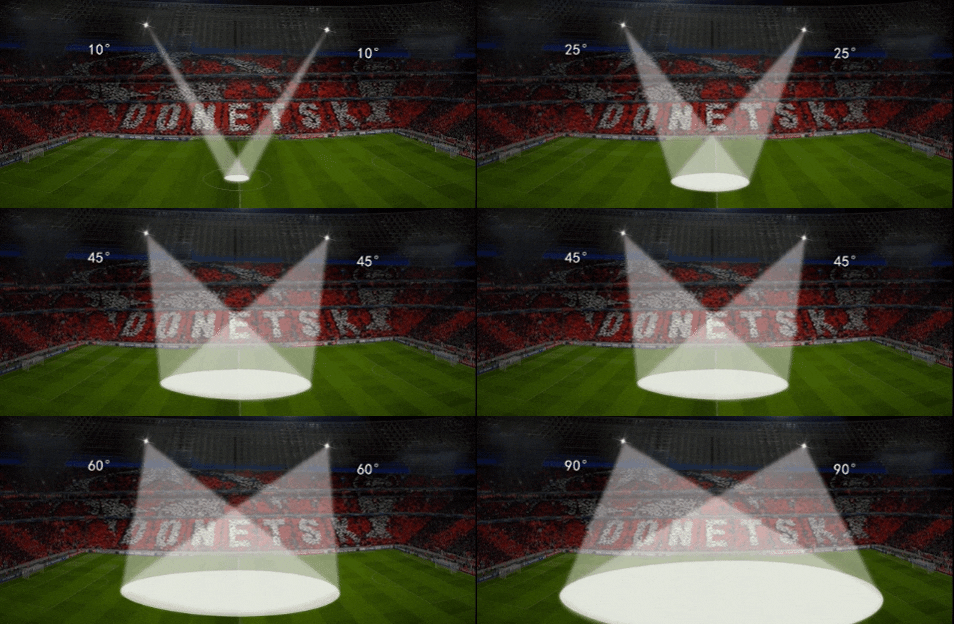
The National Electrical Manufacturers Association (NEMA) defines light distribution patterns for luminaires based on their beam angles, specifically for applications such as sports and floodlighting. These classifications help identify the most suitable luminaire for achieving optimal lighting performance in a given setting. NEMA classifications are categorized into seven types, each addressing different beam widths and applications.

NEMA Light Distribution for Sports and Flood Lighting
NEMA Type 1 (Very Narrow)
– Beam Angle: Less than 10 degrees.
– Applications: Ideal for spotlighting and illuminating tall structures or long distances, such as high towers or architectural details.
NEMA Type 2 (Narrow)
– Beam Angle: 10 to 18 degrees.
– Applications: Suitable for precise lighting needs, such as small sports courts or focused floodlighting in specific areas.
NEMA Type 3 (Medium Narrow)
– Beam Angle: 18 to 29 degrees.
– Applications: Commonly used in smaller sports fields or localized floodlighting for targeted illumination.
NEMA Type 4 (Medium)
– Beam Angle: 29 to 46 degrees.
– Applications: A versatile choice for mid-sized sports fields, parking lots, or general floodlighting.
NEMA Type 5 (Medium Wide)
– Beam Angle: 46 to 70 degrees.
– Applications: Used for larger areas requiring broader illumination, such as recreational sports fields or parking facilities.
NEMA Type 6 (Wide)
– Beam Angle: 70 to 100 degrees.
– Applications: Best for large sports fields, stadiums, and other expansive outdoor areas requiring uniform lighting.
NEMA Type 7 (Very Wide)
– Beam Angle: Greater than 100 degrees.
– Applications: Designed for wide-area lighting, such as public parks or large industrial zones, where uniform illumination across a broad expanse is critical.
What Type of Lighting is Used in Outside Areas?
Outdoor lighting is essential for enhancing safety, functionality, and aesthetics in a variety of external spaces. The type of lighting used depends on the application, whether it’s for streets, parking lots, sports fields, building exteriors, or recreational areas. Let’s explore the most common types of outdoor lighting and their applications.
1. LED Street Lights
- Description: Designed to illuminate roadways and sidewalks, LED street lights provide uniform, energy-efficient lighting for public spaces.
- Applications: Used in streets, highways, and urban pathways to ensure safe navigation for pedestrians and drivers.
- Features: High energy efficiency, long lifespan, and directional lighting to reduce light pollution.
2. Flood Lights
- Description: Flood lights offer broad, high-intensity illumination for large areas.
- Applications: Commonly used for stadiums, sports fields, industrial zones, and parking lots.
- Features: Adjustable beam angles, high lumen output, and durability for outdoor conditions.
3. Wall-Mounted Fixtures
- Description: Installed on building exteriors to provide perimeter lighting and enhance architectural features.
- Applications: Used in commercial buildings, residential complexes, and public spaces.
- Features: Durable and weather-resistant with options for motion sensors to improve security.
4. Bollard Lights
- Description: Short, ground-mounted fixtures designed for pathway lighting.
- Applications: Ideal for gardens, parks, and walkways to create ambiance and guide pedestrians.
- Features: Low-intensity, decorative, and energy-efficient options.
5. High Mast Lights
- Description: Tall lighting structures equipped with multiple luminaires to illuminate large outdoor areas.
- Applications: Suitable for highways, stadiums, and airport tarmacs.
- Features: High brightness, wide coverage, and minimal maintenance.
6. Area Lights
- Description: Provide wide, uniform illumination for open spaces.
- Applications: Used in parking lots, public parks, and commercial outdoor spaces.
- Features: High lumens, weatherproof design, and energy efficiency.
The choice of outdoor lighting depends on the specific requirements of the area, whether it’s enhancing safety, functionality, or aesthetics. LEDs have become the most popular choice due to their energy efficiency, longevity, and versatility across various applications.

Lighting Distribution Applied in Outdoor Luminaires
Choosing the appropriate lighting distribution for outdoor luminaires ensures optimal illumination, energy efficiency, and safety. Different outdoor applications require specific light distribution types to meet their unique demands. Below is an overview of lighting distribution as applied in various outdoor luminaires.
Street and Roadway Lighting
- Description: Designed to provide uniform illumination along roadways and pedestrian paths.
- Preferred Distribution Types:
- Type II: Narrow, asymmetric distribution for small roads and walkways.
- Type III: Wide, asymmetric pattern for larger streets and roadways.
- Type IV: Forward-throw distribution for roadway intersections and wide streets.
- Applications: City streets, highways, and residential roads.
Post Top Lighting
- Description: Decorative lighting mounted on posts for pedestrian pathways and public spaces.
- Preferred Distribution Types:
- Type V: Symmetrical, circular distribution to provide even illumination in all directions.
- Type VS: Symmetrical square distribution for uniform lighting in plazas and gardens.
- Applications: Parks, sidewalks, courtyards, and urban plazas.
Parking Lot Lighting
- Description: Provides safety and visibility for vehicles and pedestrians in parking areas.
- Preferred Distribution Types:
- Type III: Wide distribution to cover large parking spaces efficiently.
- Type IV: Forward-throw distribution for perimeter and edge lighting.
- Type V: Circular pattern for evenly lighting central parking zones.
- Applications: Commercial parking lots, shopping malls, and airport parking areas.
Sports Lighting
- Description: High-intensity lighting used for sports fields and stadiums to enhance player performance and spectator experience.
- Preferred Distribution Types:
- NEMA Types 1–3: Narrow beams for tall installations and focused lighting.
- NEMA Types 4–6: Medium to wide beams for large field coverage.
- Applications: Football fields, tennis courts, and multi-purpose sports arenas.
Flood Lighting
- Description: High-lumen luminaires used to illuminate large outdoor areas or highlight architectural features.
- Preferred Distribution Types:
- NEMA Types 2–6: Narrow to wide beam angles for precise or broad illumination.
- Type IV: Asymmetric forward-throw distribution for focused area coverage.
- Applications: Stadiums, industrial zones, building facades, and event spaces.
Selecting the right lighting distribution for outdoor luminaires depends on the specific application, area size, and required beam pattern. Properly chosen light distributions enhance safety, reduce energy consumption, and improve the overall functionality of outdoor spaces.

Conclusion
Selecting the perfect LED light distribution for outdoor spaces is essential for achieving optimal illumination, safety, and energy efficiency. Understanding IESNA distribution types, BUG ratings, and NEMA classifications ensures that your lighting design meets both functional and aesthetic needs. Whether you’re illuminating streets, sports fields, or building facades, the right light distribution creates a comfortable and visually appealing environment.
If you have questions or need assistance choosing the ideal light distribution for your project, feel free to contact us. Our team is here to help.


Get an Instant Quote Now
Let us help you get started with our superior LED lighting products.
Our LED Lighting experts can help to solve your issues.
Before sending your message, please note:
Your message goes to Logos Lighting and it may take time to reply to you.
Please complete all fields unless otherwise indicated. This will help us deal with your inquiry more efficiently. Alternatively, you can contact us directly via email: info@logosled.com.
Share This Article!
About the Author: Sirius Xie


